
Road test tips

20 road test tips for New York drivers

Everything our NYS DMV-certified instructors teach students before test day, from what examiners evaluate to parallel parking with confidence. Written for drivers in Nassau and Suffolk.

Student driver practicing parallel parking on a residential street

Before test day

Tip 1: Know what examiners evaluate

Examiners evaluate your driving throughout the test and record errors under New York State scoring standards, and certain unsafe actions can end the test on the spot. Counting points while you drive only splits your attention.

Focus on the fundamentals every road test covers: observation, complete stops, signaling, right of way, vehicle control, and following the examiner's instructions. Small habits repeated across a whole drive are worth fixing first. Kumer Dey breaks down the habits that cost the most in The 10 Most Common Mistakes on the New York Road Test.

Tip 2: Practice the maneuvers until they feel routine

Parallel parking and the three-point turn are common trouble spots because they combine observation, vehicle control, signaling, and positioning all at once. Practice them until they feel automatic, at a slow, controlled crawl. Speed is the enemy here: the slower the car moves, the more time you have to check mirrors and adjust.

Tip 3: Practice on everyday roads that build real skill

New York State does not allow practice driving at DMV road test sites. Build your skills on regular residential streets with stop signs, parked cars, intersections, and school zones. Those are the situations every road test covers, and they make you a better driver for life.

Tip 4: Take a mock road test with an instructor

A mock test modeled on the skills a New York road test evaluates is the fastest way to find the habits worth fixing. Book a lesson a week or two before your test so there is still time to practice what the instructor points out, then a final tune-up a day or two before. See lessons and packages.

Tip 5: Gather your paperwork early

Put everything in one folder a few days ahead: your physical photo learner permit, your original MV-278 or MV-285 certificate (copies are not accepted), and a completed MV-262 signed by a parent or guardian if you are under 18. If your permit requires glasses or contacts, bring them.

Tip 6: Get the test car ready and learn its controls

The vehicle needs valid registration, insurance, and inspection, plus permanent license plates. Check that the turn signals, brake lights, horn, and wipers work, and that the car is clean inside. Know where the headlights, wipers, defroster, and hazard lights are before you sit down with the examiner.

If the car has a backup camera, parking sensors, or other driver assistance features, read the DMV guidelines for testing in those vehicles, linked from the DMV's road test page, so nothing on test day comes as a surprise.

On test day

Tip 7: Arrive early and check for weather updates

Plan to arrive up to 15 minutes before your appointment. Arriving late can mean rescheduling. Tests can be canceled or moved for bad weather or road work, so check the DMV's cancellations and closings page before you leave. If it is raining, remember that New York requires your headlights to be on whenever your wipers are running because of the weather.

Tip 8: Bring the right accompanying driver

Your accompanying driver needs a valid physical license: 18 or older if they drive you to the site, 21 or older if you drive there. Only the accompanying driver may be in the car, so leave friends and siblings at home.

Tip 9: Set up the car before you move

Adjust your seat, mirrors, and headrest, fasten your seat belt, and make sure every occupant is buckled before you start. A calm, deliberate setup routine shows the examiner you are in control and keeps you focused from the first minute.

Behind the wheel

Tip 10: Make every observation visible

Examiners can only score what they can see. Turn your head for mirror checks and look over your shoulder before pulling away from the curb, changing lanes, and backing up. Quick eye movements that keep your head still are easy for an examiner to miss.

Tip 11: Signal early, every time

New York law requires you to signal continuously for at least the last 100 feet before a turn. Signal before pulling out from the curb, before every lane change, and before pulling back in to park, even when no one else is around.

Tip 12: Come to complete stops behind the line

At stop signs and red lights, stop fully behind the stop line or crosswalk, with the car completely still. Then, if you cannot see cross traffic, creep forward slowly for a clear view before proceeding.

Tip 13: Yield the right of way with confidence

Yield to pedestrians in crosswalks, to traffic already in an intersection, and to oncoming cars when turning left. Once the way is clear, go decisively. Smooth, confident decisions show the examiner you understand the rules.

Tip 14: Match your speed to the posted limit and the conditions

Keep to the posted limit, slow down in school zones and around parked cars, and adjust for weather and traffic. Driving well below the limit for no reason can also be scored, so aim for steady, appropriate speed.

Tip 15: Drive with smooth, centered control

Keep the car centered in the lane, leave a following distance of a few seconds behind the car ahead, and give parked cars and cyclists room. Keep both hands on the wheel, turn with smooth, controlled movements, and brake and accelerate gently. A calm, steady drive is what experienced driving looks like from the passenger seat.

Tip 16: Treat railroad crossings with extra care

Long Island has railroad crossings across both counties. When the signals flash, the gates are down, or a train is approaching, stop at least 15 feet and no more than 50 feet from the nearest rail and wait until it is safe. Never stop on the tracks: before you cross, make sure there is room for your whole car on the other side.

Tip 17: Know the school bus and school zone rules

When a school bus stops with its red lights flashing, stop, whether you are behind the bus or approaching from the opposite direction, and stay stopped until the lights go off. Watch for children near the bus, and slow down to the posted speed in school zones.

The maneuvers

Tip 18: Parallel park with reference points

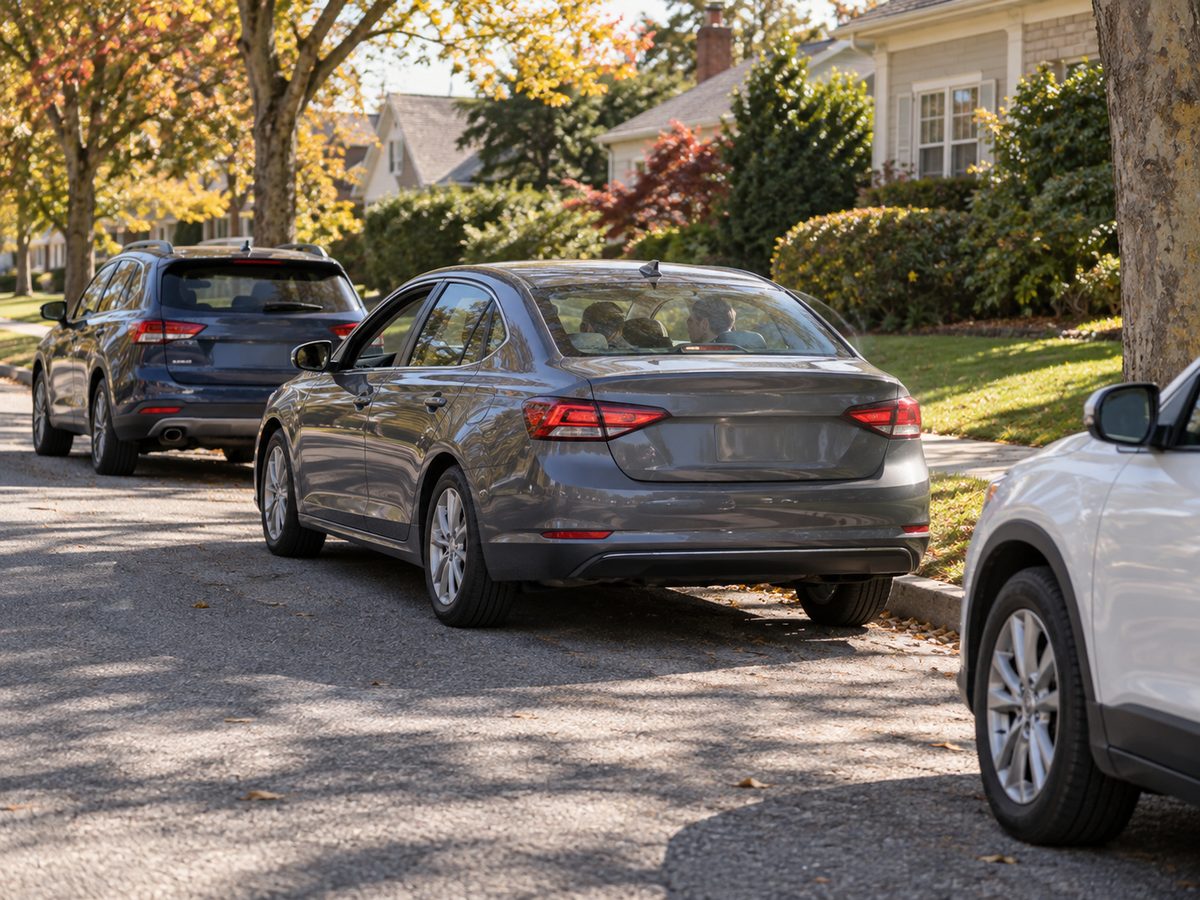
Signal, line up beside the front car with a comfortable gap, and back in slowly using the reference points your instructor taught you. Check your mirrors and look around throughout the maneuver. Finish straight, close to the curb, and with your tires clear of it. A careful, slightly slower park beats a fast one every time.

Tip 19: Complete the three-point turn in three movements

Signal, check traffic in both directions, and pull forward across the road. Look over your shoulder before you reverse, then check again before the final move forward. Keep every movement slow and controlled and finish in three moves.

Mindset and after the test

Tip 20: Keep driving your best after a mistake

One error rarely decides a test, but letting it rattle you can. If you make a mistake, take a breath and focus on the next instruction. If you miss a direction, it is fine to ask the examiner to repeat it. Results post online after 6 pm on test day at the DMV results site. If you need another attempt, you can retest after 14 days, and your permit stays valid until it expires.

Quick answers

Road test questions

How is the New York road test scored?

Road test examiners evaluate your driving throughout the test and record errors based on New York State scoring standards, and certain unsafe actions can result in an unsuccessful test. Rather than counting points while driving, focus on observation, complete stops, signaling, right of way, vehicle control, and the examiner's instructions.

Can I practice at the road test site?

New York State does not allow practice driving at DMV road test sites. Practice on everyday residential streets with stop signs, intersections, and parked cars, which is exactly what the test covers.

How soon can I retake the road test?

You must wait at least 14 days. Your learner permit stays valid until its expiration date, and additional fees apply after your first two road tests.

What should I bring to my road test?

Your physical photo learner permit, your original MV-278 or MV-285, a completed MV-262 if you are under 18, any required glasses or contacts, a registered, insured, and inspected vehicle, and a qualifying accompanying driver.

Requirements come from the NYS DMV and can change. Confirm current rules on the DMV road test page, and see our driver resources for more official links.

Walk into your road test ready

Book road test prep in Hicksville or Ronkonkoma.